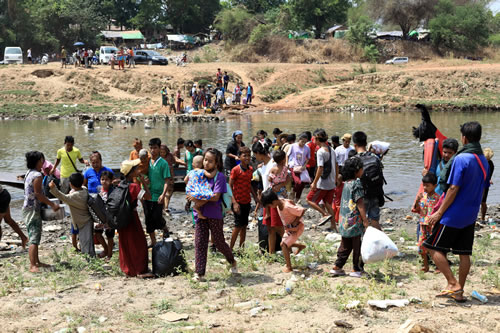
In Myanmar, formerly Burma, the Columban Mission Office team leads the Myanmar Mission Unit in facilitating activities and programs that respond to the Columban mission priorities on biodiversity conservation and accompany refugees.
Besides the celebration of the Laudato Sì week, the Columban missionaries also visited internally displaced peoples’ (IDP) camps now increasing and growing in number.
The ongoing conflict has displaced more and more people from areas previously left untouched by the war. “Entire villages have been burned one house after another,” one displaced mother shared. She added that many of them have been moving from one camp to another. Another young mother shared that there is no chance to return to their villages or their farms because of the presence of Burmese soldiers.
I tagged along with Fr. La Lung, the Diocesan Youth Director and also a member of the Diocesan Emergency Response Team (DERT), as he visited Namti and Mogaung. We first arrived at Namti Parish, which hosts families displaced from Lawa and its nearby villages. Since March 2025, they had left their villages and moved to Namti town, where the parish temporarily sheltered them. In June, the township allowed the displaced families to rent government land where they are now building a more “permanent” shelter from bamboo and tarpaulin sheets. When the wind blows, and it rains, it can be cold and wet.
Fr. La Lung asked the camp head to share what their urgent needs were. The camp head mentioned that a total of 400 families are expected to stay in the camp. There are currently about 300 already settled, and 100 more are still coming. But they only have eleven toilet facilities, and the water supply is not enough. They fear that an outbreak of sanitation-related diseases will happen.
We slept overnight at Namti Parish, hosted by Fr. Tu Hkawng, the local parish priest. The next day, we visited St. Peter’s Parish in Mogaung, which hosted more displaced families from Kamaing and other nearby villages. One catechist mentioned that their food supplies are depleting. And there are more families trapped in the forests, afraid to leave and be displaced from one place to another.
Last month, Michael, Cata and I also visited Nawng Chin Parish and spoke with the parish leaders. The parish was only created last year, but now it is hosting ten camps spread all over its area. When the conflict escalated in a nearby parish, families moved to Nawng Chin Parish. The most recent survey listed 1,707 individuals spread over ten camps. Five camps are close to the church compound, while another five more camps are spread over the parish. New shelters are being built in two camps, but the other camps also need repair of their shelters. Most camps face difficulties in responding to basic needs like food, shelter, water and electric power supply.
The number of families and individuals displaced by the ongoing conflict continues to increase. But the reduction in international humanitarian assistance to displaced peoples in Myanmar has greatly affected the response to their growing needs. We continue to pray but also seek resources to help respond to their urgent needs. We thank you for continuing to support our efforts to respond to the needs of the families and individuals here in Myanmar, particularly the urgent needs of the internally displaced families and individuals.
Columban Fr. Kurt Zion Pala lives and works in Myanmar (formerly Burma).