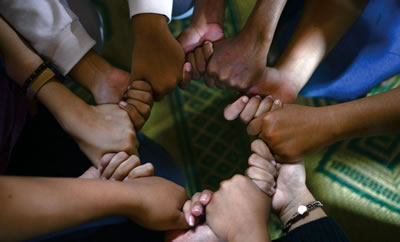
When I was younger, people often noticed my hands. Some would remark that they were smooth, unmarked, even beautiful. Others assumed that perhaps I did not help with household chores, or that I came from a wealthy family where work was unnecessary. But those assumptions were far from the truth. I grew up in a poor farming family, and daily chores and farm labor shaped my hands. The soil, the tools, the endless rhythm of planting and harvesting— all of these left their quiet imprint. My hands carried stories that were not visible at first glance, stories of hidden labor and endurance.
As I grew older, I began to understand that hands are more than physical features. They are living testimonies of the lives we live and the sacrifices we make. My own hands, though once mistaken for signs of privilege, were in fact marked by unseen work. Later, as a high school teacher, I held pen and chalk day after day, guiding students through lessons. Even in the classroom, my hands bore witness to both discipline and care. They reminded me that beauty does not come from ease, but from endurance. Through these experiences, I learned to see hands not merely as ornaments but as symbols of resilience, sacrifice, and love.
This understanding deepened when I entered migrant ministry at the Hope Workers Center in Taiwan. Part of my work is to accompany migrant workers in their faith journeys, and one of the most humbling moments is serving alongside them at the altar. Migrant ministry is not only about offering programs or services—it is about walking with people in their struggles and joys, listening to their stories, and affirming their dignity. It is about creating spaces where faith and community can sustain those who are emotionally and physically far from home.
I will never forget the first time I placed the Body of Christ into the hands of a migrant worker. I was stunned. Before me were calloused hands—rough, worn, marked by years of labor. And yet, upon them rested Jesus Himself. The sight touched me profoundly. Those callouses were not only signs of hardship; they were living proof of hard work, sacrifice, and resilience. But what moved me even more was not simply their willingness, but their deep desire to receive Jesus in the Holy Eucharist. After long hours in factories, households, and hospitals, after nights with little rest, they still came forward with faith and gratitude. Their hands, hardened by toil, opened with reverence. Their bodies, weary from labor, stood as witnesses of devotion. Their faith was stronger than fatigue, their longing for Christ greater than exhaustion. In their eyes and in their hands, I saw a hunger for God that no hardship could diminish.
“Come to me, all you who labor and are burdened, and I will give you rest.” (Matthew 11:28)
In their perseverance, I saw the living echo of Christ’s words: “Come to me, all you who labor and are burdened, and I will give you rest.” (Matthew 11:28) The Eucharist was not only their refuge—it was their joy, their strength, their thanksgiving. Even when the world demanded everything from them, they still offered the little time and energy they had to God, because their hearts longed for Him above all.
The Church teaches that work is not only a way to earn a living but also a participation in God’s creation. St. John Paul II, in Laborem Exercens, reminds us that labor is a vocation, a way of sharing in the Creator’s ongoing work. For migrant workers, this truth shines brightly: their labor sustains their families, communities and countries, and their faith sustains their spirit. To see them come forward, tired yet joyful, is to witness a profound testimony—that gratitude and devotion are stronger than fatigue, and that holiness can be found in the most ordinary gestures of daily life.
Sometimes people with calloused hands feel shy to show them or to be held by others, because they appear rough or unattractive. I, too, once misunderstood them in this way. But now I see that these hands, though worn, carry hidden beauty. They are not marks of shame, but of dignity— living witnesses of labor, sacrifice, and love.
The calloused hands I once misunderstood now appear to me as sacred. They are living witnesses of human struggle and divine grace, meeting in the Eucharist. They remind us to honor the unseen workers whose hands sustain our communities, and to recognize in them the hidden beauty of perseverance and faith.
As I reflect on my own journey, I see that my hands—once misunderstood—carry the same story. They connect me to the workers I serve, to the farmers who raised me, and to the countless laborers whose hands build, carry, and nurture life. In their callouses, I see resilience. In their callouses, I see love. In their callouses, I see Christ.
Columban lay missionary Reins Mosqueda is from the Philippines. She lives and works in Taiwan.