Five relationships are fundamental to traditional Chinese Confucian thought. Together they emphasize the importance of social order and interpersonal dynamics. These five are:
- Ruler and subject
- Father and son
- Elder brother and younger brother
- Husband and wife
- Friend and friend
These relationships exemplify the proper roles and responsibilities within society, guiding people to fulfill their duties and maintain harmony. Confucianism emphasizes the importance of respecting and fulfilling one’s role within these relationships.
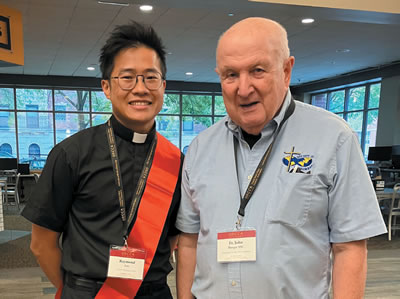
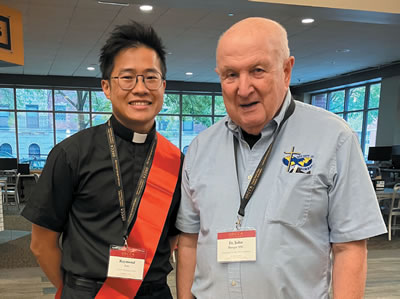
Where should we characterize the relationship between the Missionary Society of St. Columban (originally founded for mission work in China) and the Catholic Church in China today? Well, the “friend and friend” relationship is probably where we Columban missionaries would prefer to see ourselves placed. That position was given affirmation recently when I attended the 29th International Conference of the U.S.- China Catholic Association at DePaul University in Chicago. The theme of the conference was “Our Hope is in Christ.”
At the opening session of the conference, Dr. Anthony E. Clark of Whitworth University spoke movingly. He retold an ancient Chinese parable about how “when one keeps the hill green, there is no fear of looking for firewood.” Dr. Clark then went on to give a short historical survey illustrating how over centuries, despite difficulties, the hill of Chinese Catholicism has been kept green despite multiple setbacks. He also spoke of how Matteo Ricci advocated the friend-and-friend approach to evangelization. Incidentally, just last year, recognizing that Matteo Ricci “lived the Christian virtues to a heroic degree,” Pope Francis officially put the famous 16th-century Italian Jesuit missionary to China on the path to sainthood declaring him venerable.
The Sino-Vatican agreement of 2018 that was renewed in 2020 has been controversial, but Dr. Clark reminded us that as one can read in the Catechism of the Catholic Church, “To avoid rash judgment, everyone should be careful to interpret insofar as possible his neighbor’s thoughts, words, and deeds in a favorable way: Every good Christian ought to be more ready to give a favorable interpretation to another’s statement than to condemn it.”
Father Augustine Tsang, S.J., from Taiwan and Bishop Junmin Pei from Manchuria gave hope-filled talks about the creative pastoral initiatives being carried out in China, despite challenges related to urbanization, secularization, materialism and fewer vocations.
There is indeed much work to be done. Although she was not the last to speak, I would like to close this article by quoting Maryknoll Sister Antoinette Gutzler who, speaking of doing theology in East Asia, quoted the sage, Chuang Tzu, who in his story of the woodcarver said:
“I am only a workman;
I have no secret. There is only this:
When I began to think about the work
you commanded, I guarded my spirit,
did not expend it on trifles that were not
to the point.
I fasted in order to set my heart at rest.”
Columban Fr. John Burger lives and works in the U.S.